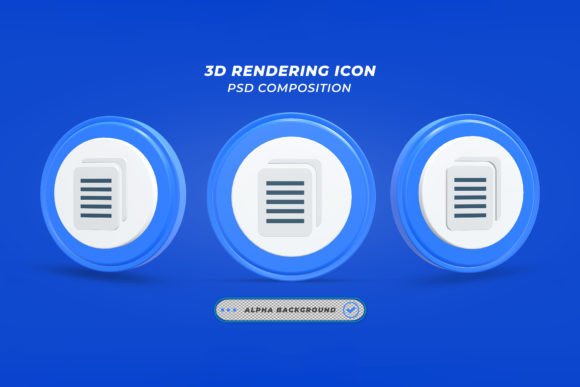
Evaluating List Book Icon in 3D Rendering for Professional Design Workflows
In the evolving landscape of digital design, the demand for high-quality visual assets continues to grow. Among these assets, the List Book Icon in 3d Rendering has emerged as a valuable resource for designers seeking to enhance their presentations, marketing materials, and user interfaces. This article explores the practical applications, technical specifications, and strategic considerations associated with using pre-rendered 3D icons, helping you determine if this specific asset aligns with your project requirements.
Understanding the Asset: What Is a 3D Rendered Book Icon?
A List Book Icon in 3d Rendering is not merely a flat graphic but a dimensional representation of a book or list symbol, created using advanced three-dimensional modeling software. Unlike traditional two-dimensional vector icons, 3D renders offer depth, shadow, and realistic lighting effects that can significantly elevate the perceived quality of a design project. These assets are typically delivered as high-resolution image files, often accompanied by editable source files such as PSD (Photoshop Document) formats, allowing for extensive customization.
The primary appeal of such an icon lies in its versatility. Whether used in educational technology platforms, library databases, e-commerce bookstores, or corporate reporting tools, a well-rendered 3D icon can serve as a focal point that draws user attention while maintaining professional aesthetics. The "list" aspect often implies organization, cataloging, or documentation, making it particularly relevant for applications involving data management or content curation.
Technical Specifications and Usability
When evaluating digital assets, technical quality is paramount. A premium List Book Icon in 3d Rendering should meet rigorous standards to ensure it performs well across various media. Key technical features to consider include:
- High Resolution: Top-tier templates often provide resolutions up to 4500 x 3000 pixels. This ensures that the icon remains crisp and detailed even when scaled for large-format prints or high-density displays.
- Print-Ready DPI: A resolution of 300 DPI (dots per inch) is the industry standard for professional printing. Assets meeting this criterion can be confidently used in brochures, posters, and physical marketing collateral without pixelation.
- Smart Object Integration: One of the most significant usability features is the inclusion of Smart Object layers in PSD files. This allows users to double-click the layer, edit the content or colors, and save changes that automatically update the main composition. This workflow drastically reduces editing time and minimizes the risk of destructive edits.
- Organized File Structure: Well-organized layers facilitate easier navigation within the design file. Designers can quickly isolate elements, adjust lighting, or modify textures without sifting through cluttered layer stacks.
The ease of use is a critical factor for many professionals. Templates designed with the aim of simplifying the user experience allow for rapid deployment. With just a few clicks, designers can integrate the icon into their existing projects, change colors to match brand guidelines, and export the final result in various formats, including JPG and PNG.
Benefits of Using Pre-Rendered 3D Icons
Opting for a pre-made List Book Icon in 3d Rendering offers several strategic advantages over creating custom 3D models from scratch:
- Time Efficiency: Creating high-quality 3D models requires specialized skills in software like Blender, Cinema 4D, or Maya, along with significant time investment for modeling, texturing, and rendering. Using a pre-rendered asset bypasses this lengthy process.
- Cost-Effectiveness: Hiring a 3D artist or purchasing expensive software licenses can be prohibitive for small teams or freelancers. Downloadable templates provide a cost-effective alternative while maintaining high visual standards.
- Consistency: For projects requiring multiple icons, using a cohesive set of 3D renders ensures visual consistency. This helps in building a strong brand identity and improves user recognition.
- Accessibility: Even designers with limited 3D experience can utilize these assets effectively thanks to intuitive features like smart object replacement and easy color editing.
Considerations and Tradeoffs
While the benefits are substantial, it is essential to approach the use of stock 3D assets with a clear understanding of their limitations. One primary consideration is uniqueness. Since these templates are available to multiple users, there is a possibility that other designs may feature similar visuals. To mitigate this, designers should leverage the editable nature of the files to customize colors, lighting angles, or backgrounds, thereby creating a more distinct look.
Another tradeoff involves flexibility. While smart objects allow for some customization, they do not offer the same level of control as a native 3D model. If a project requires dynamic animations, interactive 3D elements, or specific geometric alterations that go beyond surface-level edits, a pre-rendered image may not suffice. In such cases, investing in custom 3D modeling might be necessary.
Additionally, users must be aware that images included in preview presentations are often examples for demonstration purposes only. It is crucial to verify exactly what is included in the download package—typically the PSD and JPG files—to avoid expectations mismatch regarding additional assets or props.
When to Choose This Asset
The List Book Icon in 3d Rendering is an ideal choice in several scenarios:
- Marketing Campaigns: When launching a new educational product, ebook, or library service, a high-impact 3D icon can enhance ad creatives and landing pages.
- UI/UX Design: For applications that benefit from a modern, tactile feel, 3D icons can improve the visual hierarchy and user engagement compared to flat icons.
- Presentation Decks: Corporate presentations or academic lectures can gain professionalism and visual interest through the use of high-resolution 3D graphics.
- Rapid Prototyping: Designers needing quick visual placeholders for client reviews can use these templates to convey concepts efficiently before committing to custom development.
When to Consider Alternatives
Conversely, there are situations where alternative approaches may be more suitable. If your project demands real-time interactivity, such as in a video game or a web-based 3D configurator, a static image will not meet the technical requirements. Similarly, if brand differentiation is the highest priority and budget allows, commissioning a bespoke 3D model ensures complete exclusivity.
Furthermore, for minimalist design systems that strictly adhere to flat design principles, a 3D icon might appear incongruous. In such cases, sticking to vector-based flat icons would maintain design coherence.
Making the Right Decision
Selecting the right visual assets involves balancing quality, convenience, and project goals. The List Book Icon in 3d Rendering represents a strong middle ground, offering high-quality visuals with minimal technical overhead. By leveraging features like smart object replacement and high-resolution outputs, designers can achieve professional results efficiently.
Before downloading, assess your specific needs: Do you require print-ready quality? Is ease of editing a priority? Does the aesthetic align with your brand? If the answer to these questions is yes, this type of asset can significantly streamline your workflow. Always review the included file types and usage rights to ensure they comply with your project’s legal and technical requirements. By making informed choices, you can enhance your design portfolio and deliver compelling visual experiences to your audience.